
Why a moving vehicle can feel uncomfortable
The most widely accepted explanation involves a mismatch among signals from the eyes, inner ear, and body. A close visual task can look stationary while the inner ear senses acceleration, turns, or waves. Cars, buses, trains, aircraft, and boats can all create that conflict.
People differ. The same seat, the same book, or the same stretch of road can feel fine one day and rough the next. That is why public-health writing on this topic is careful: behavioral approaches exist, but none works for everyone, and most are only partly helpful.
What this guide is—and is not
This page summarizes non-medication options described in government health guidance and shows where AntiSick fits as an optional toolkit. It does not diagnose a condition, recommend medication, or promise a particular outcome. If symptoms are severe, persistent, unusual, or worrying, talk with a qualified healthcare professional.
Non-medication options to consider
Government health guidance describes several behavioral approaches. You can try one at a time and keep whatever feels useful:
- Find outside visual context. Looking toward a distant horizon or forward view can reduce the visual-motion mismatch for some passengers.
- Pause close-up visual tasks. Reading and visual scanning can make symptoms worse in some transport environments.
- Keep head movement gentle. A stable, supported position may feel better than repeated movement.
- Try controlled breathing. Follow a regular, comfortable pace rather than forcing unusually deep or fast breaths.
- Use calm sensory input. Fresh air or music may be useful distractions for some people.
What to try first
Start with the least demanding change. Face forward if you can, support your head, and look toward a distant view instead of a nearby page. If you need the phone, pause scrolling and glance rather than reading continuously. If looking at a screen still feels wrong, switch to something you can hear, or follow a slow breathing rhythm with your eyes resting.
Give each change a short, honest try. If it makes you feel worse, stop. There is no requirement to finish a technique that is not helping.
Where AntiSick fits
AntiSick collects three optional approaches in one app: motion-linked visuals, soothing audio, and guided breathing. The goal is to make these tools easy to start during a ride—not to diagnose a condition or promise a medical outcome.
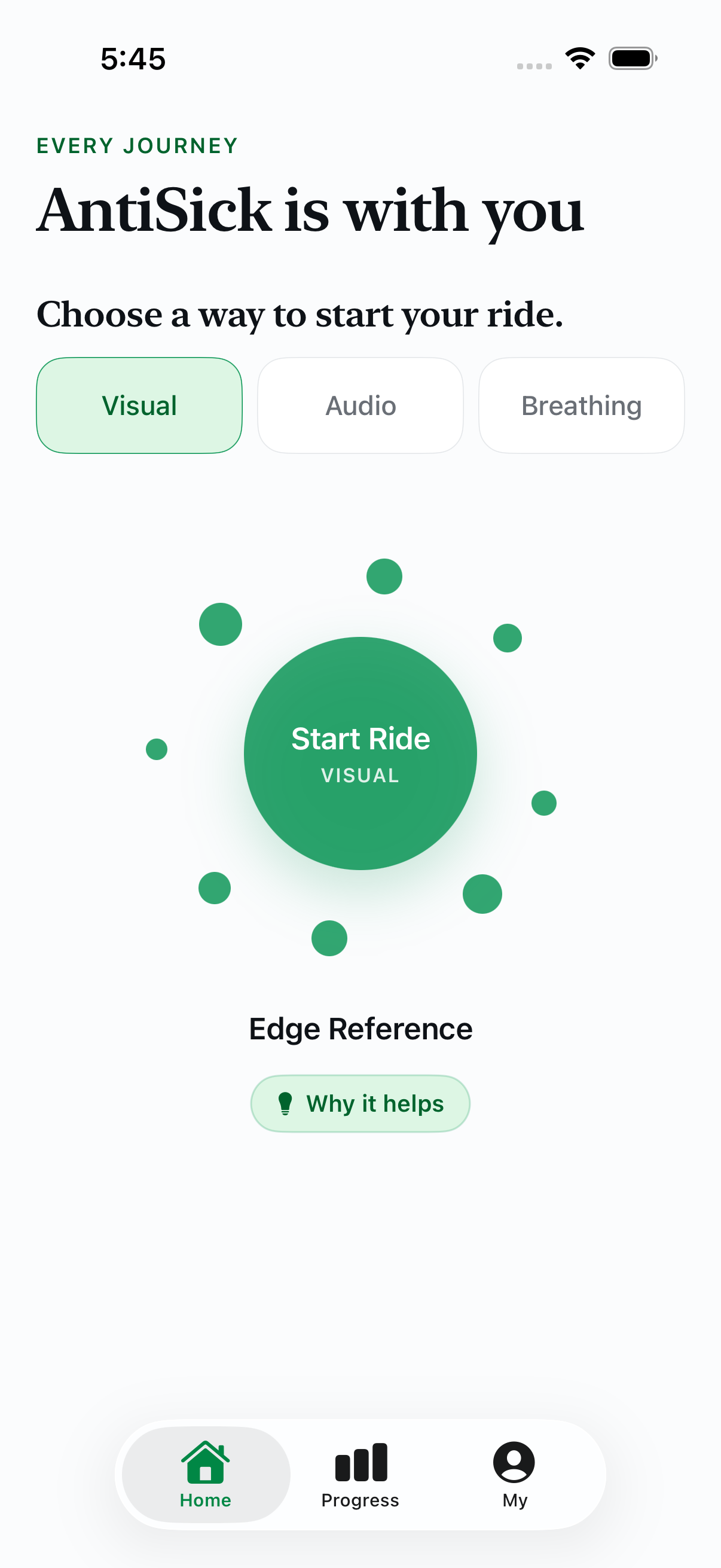
Choose one mode at a time. Visual is for passengers who want a motion-linked reference, including a user-started Floating Window in Standard Visual. Audio is for passengers who would rather listen than look, including a short 100 Hz balance-tone option. Breathing offers an unhurried rhythm with optional voice and haptic cues. Journey notes stay on your device and can help you remember which setup felt useful.
Keep volume comfortable, and stop if the experience makes you feel worse. AntiSick is for passengers, never drivers.
Health note: Seek advice from a qualified healthcare professional for severe, persistent, unusual, or concerning symptoms. Medication decisions—especially for children, pregnancy, or other health conditions—need individual professional guidance.
Choose what feels right for the ride
Start with one free ride in each AntiSick mode. AntiSick is for passengers, never drivers.
Questions
What can passengers try without medicine?
Public health guidance describes behavioral options such as looking toward a distant view, pausing close-up reading, keeping head movement gentle, using a regular breathing pace, and adding calm sensory input. None works for everyone, and most are only partly helpful.
Does looking at the horizon help?
A distant horizon or forward view can give some passengers clearer visual context than a nearby page or screen. It is not a reliable fix for every person or every vehicle.
Is AntiSick medical care?
No. AntiSick is a comfort toolkit, not a medical device, and it is not a substitute for professional care.
When should I talk to a clinician?
Seek advice from a qualified healthcare professional for severe, persistent, unusual, or concerning symptoms, and before using medication—especially for children, pregnancy, or other health conditions.
Sources
This educational overview is not a substitute for professional medical care.